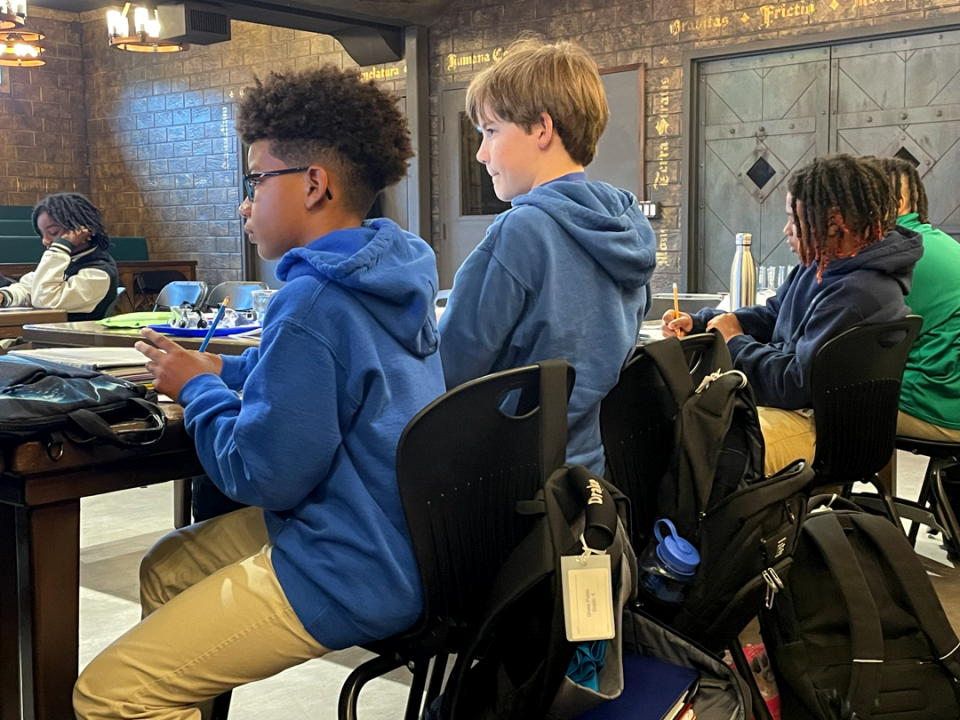


Chris Berdik for The Hechinger Report Science teacher Daniel Thompson circulated among his sixth graders at South Atlanta’s Ron Clark Academy on a recent spring morning, spot-checking their work and leading them into discussions about the day’s lessons on weather and water. He had a helper: As Thompson paced around the class, peppering them with questions, he frequently turned to a voice-activated artificial intelligence to summon apps and educational videos onto large-screen smartboards. When a student asked, “Are there any animals that don’t need water?” Thompson put the question to the AI. Within seconds, an illustrated blurb about kangaroo rats appeared before the class. Thompson’s voice-activated assistant is the brainchild of computer scientist Satya Nitta, who founded a company called Merlyn Mind after many years at IBM where he had tried, and failed, to create an AI tool that could teach students directly. As The Hechinger Report explains, the foundation of that earlier, ill-fated project was IBM Watson, the AI that famously crushed several “Jeopardy!” champions. Despite Watson’s gameshow success, however, it wasn’t very good at teaching students. After plowing five years and $100 million into the effort, the IBM team admitted defeat in 2017. “We realized the technology wasn’t there,” said Nitta, “and it’s still not there.” Since the November 2022 launch of OpenAI’s ChatGPT, an expanding cast of AI tutors and helpers have entered the learning landscape. Most of these tools are chatbots that tap large language models — or LLMs — trained on troves of data to understand student inquiries and respond conversationally with a range of flexible and targeted learning assistance. These bots can generate quizzes, summarize key points in a complex reading, offer step-by-step graphing of algebraic equations, or provide feedback on the first draft of an essay, among other tasks. Some tools are subject-specific, such as Writable and Photomath, while others offer more all-purpose tutoring, such as Socratic (created by Google) and Khanmigo, a collaboration of OpenAI and Khan Academy, a nonprofit provider of online lessons covering an array of academic subjects. As AI tools proliferate and their capabilities keep improving, relatively few observers believe education can remain AI free. At the same time, even the staunchest techno optimists hesitate to say that teaching is best left to the bots. The debate is about the best mix — what are AI’s most effective roles in helping students learn, and what aspects of teaching should remain indelibly human no matter how powerful AI becomes? Skepticism about AI’s place in the classroom often centers on students using the technology to cut corners or on AI’s tendency to hallucinate, i.e. make stuff up, in an eagerness to answer every query. The latter concern can be mitigated (albeit not eliminated) by programming bots to base responses on vetted curricular materials, among other steps. Less attention, however, is paid to an even thornier challenge for AI at the heart of effective teaching: engaging and motivating students. Nitta said there’s something “deeply profound” about human communication that allows flesh-and-blood teachers to quickly spot and address things like confusion and flagging interest in real time. He joins other experts in technology and education who believe AI’s best use is to augment and extend the reach of human teachers, a vision that takes different forms. For example, the goal of Merlyn Mind’s voice assistant is to make it easier for teachers to engage with students while also navigating apps and other digital teaching materials. Instead of being stationed by the computer, they can move around the class and interact with students, even the ones hoping to disappear in the back. Others in education are trying to achieve this vision by using AI to help train human tutors to have more productive student interactions, or by multiplying the number of students a human instructor can engage with by delegating specific tasks to AI that play to the technology’s strengths. Ultimately, these experts envision a partnership in which AI is not called on to be a teacher but to supercharge the power of humans already doing the job. How Well Are Students Engaging in AI?
As AI ascends, education experts debate which aspects of teaching should remain human