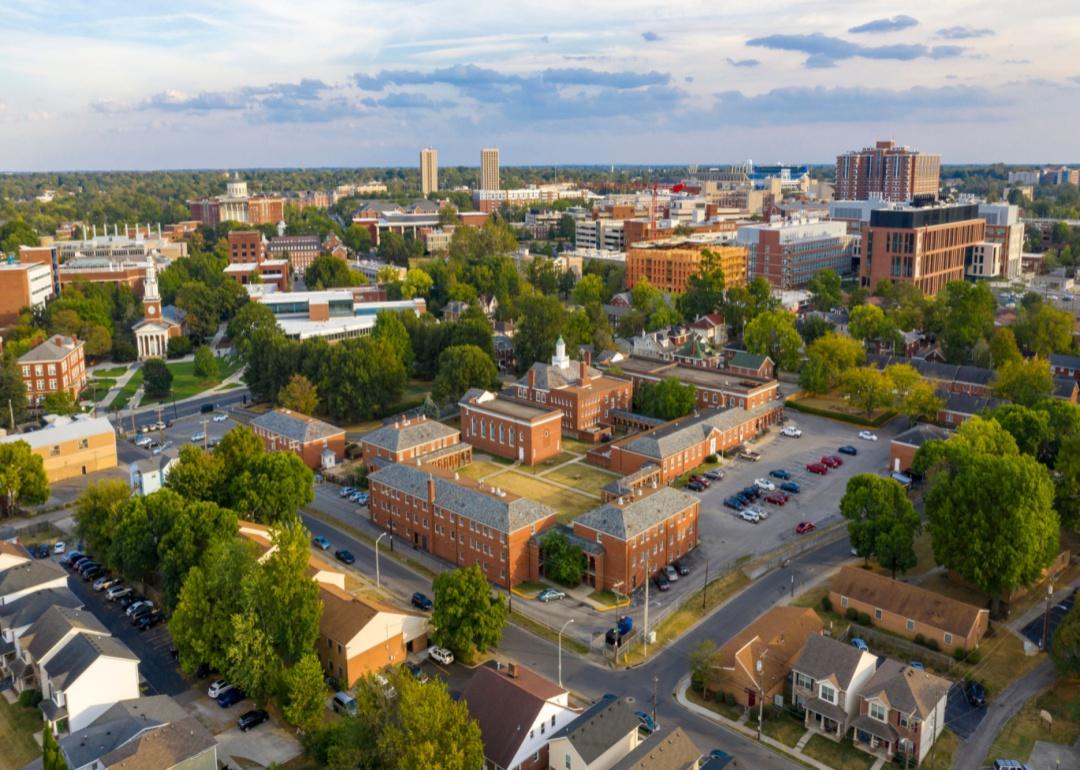


Chetty Thomas // Shutterstock COVID-19 restrictions, which kept workers and students alike at home and severely hampered mobility for those dependent on public transit, prompted many Americans to dust off the bicycles in their garages or buy new ones as a way of getting out of their homes, exercising, and reducing stress levels while adhering to social distancing guidances. Others took up walking as a means of exercise and exploration. This resulted in people discovering–in ways they perhaps had never realized before–just how bikeable and walkable their neighborhoods really were. Despite inner-city infrastructure development traditionally adopting a mixture of public transportation and vehicle-use roadways, many cities have begun to prioritize dedicated bicycle lanes and safety measures to offer better mobility options and quality of life. Cycling infrastructure investments to increase the safety and security of bike-lane networks in cities like Austin, Texas; New Orleans; and Portland, Oregon, have grown exponentially in recent years. The League of American Bicyclists found that, since 2005, there has been a 46% increase nationwide in bike commuters, and the cities where bike commuting has risen the most–Seattle, Washington D.C., and the aforementioned Portland and New Orleans being just a few examples–are also among those cities making the greatest investments in growing and securing their bike networks. Of course, within any given city, some areas are more bike-friendly than others. Velotric drew on data from WalkScore to rank U.S. neighborhoods that are far more bikeable than the cities they’re part of might suggest. The analysis was limited to 10 U.S. cities and to avoid duplicates, only the highest-scoring neighborhood from a city was included. Walk and transit scores relative to these neighborhoods and their cities are also included. The Bike Score methodology accounted for several factors, among them the preponderance of bike lanes and road connectivity as well as the existence of hills and other topographic features. Some patterns emerged: Most are old neighborhoods. Several are on the National Register of Historic Places. A few are very close to university campuses, where many students rely on bikes for transportation, and most are near–or simply are–downtown. In all cases, the following bike havens are rich in culture and rife with things to do and sights to see, all easily accessible on two wheels. #10. Downtown (Winston-Salem, North Carolina) Canva – Neighborhood bike score: 73 (43.8 points greater than Winston-Salem) – Neighborhood walk score: 79 (56.5 points greater) – Neighborhood transit score: Not available While not as big as San Diego, Winston-Salem–home to several colleges and universities–is a large enough city as a whole that most residents prefer to have cars, and car commuting is the norm. However, the downtown neighborhood has prioritized bike-friendliness by adding bike racks in public places and onto public transportation, adding bike lanes to streets, and improving nonstreet routes–like the popular Long Branch Trail–called greenways. Visitors who would like to explore the city on two wheels can rent a bike through the city’s bike share program, which has 22 stations located throughout the downtown area. Old Salem’s historic streets, myriad shops and restaurants, museums, and even the Black Mountain Chocolate Bar are all accessible by bike. #9. Gaslamp (San Diego, California) Benny Marty // Shutterstock – Neighborhood bike score: 87 (44 points greater than San Diego) – Neighborhood walk score: 97 (43.7 points greater) – Neighborhood transit score: 81 (43.7 points greater) San Diego calls to mind surfers pedaling to the beach on cruiser bikes, but this beach city is also a big city-America’s eighth most populous at nearly 1.4 million–and not as bike-friendly as you might think. Fortunately, the Gaslamp Quarter, in the very heart of San Diego, is an exception. For $20, you can rent a basic hybrid bike for four hours to explore the Quarter; another $10 gets you one all day. You can also rent a high-end road bike or e-bike and cruise the 6 miles north along the waterfront from the Quarter to Liberty Public Market. Many of the beautifully restored 19th-century Victorians in the historic district have been turned into lively restaurants and other businesses. The neighborhood serves as a shopping and dining destination by day and a hotel and nightlife district lit by–yes–gas lamps after dark. #8. Cabbagetown (Atlanta, Georgia)
Bikeable neighborhoods in not-so-bike-friendly cities